
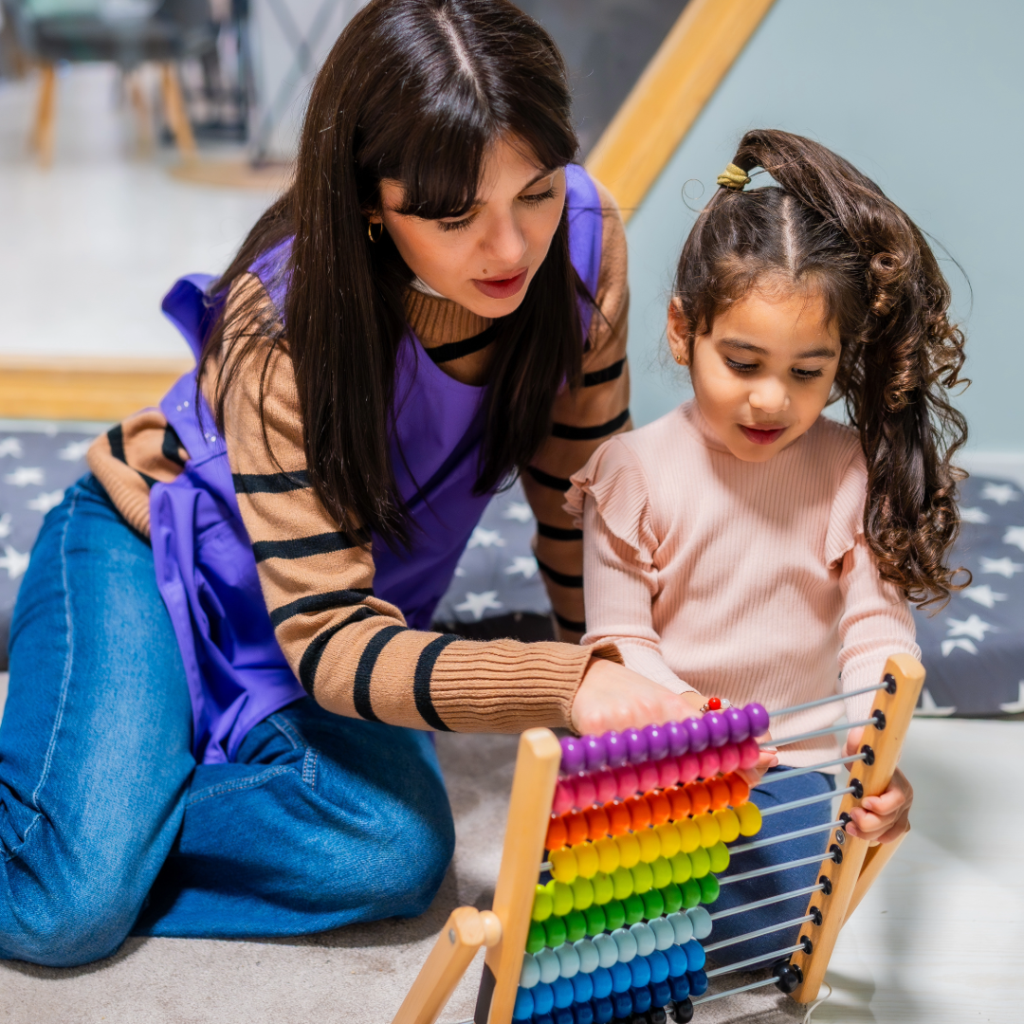
In the preschool years, math learning at home should grow naturally from children’s everyday curiosity and experiences. Young children learn best through play, exploration, and meaningful interactions with the adults who care for them. That’s why early math experiences should remain developmentally appropriate while building on children’s interests. They should create opportunities for discovery through play and connection while avoiding pressure to focus too heavily on formal academic skills.
Many of the families you work with are already supporting mathematical thinking in these ways without even realizing it. As a preschool educator, you’re uniquely positioned to help them recognize the rich math learning embedded in everyday routines. Your role and knowledge of child development sets the stage for you to encourage them to extend those experiences beyond the classroom.
Inspired by our Early Math Family Resource Guide (developed by our partners at Every Child Ready), here are five easy and joyful ways you can encourage families to turn everyday moments at home into playful, enriching learning that nurtures early math skills.
1. Rote Counting: Make It Silly
Rote counting, counting from memory rather than counting physical objects, is one of the first math skills children develop. To keep it fun and age-appropriate, suggest silly counting with families by demonstrating it at pickup or including it in a note home. For instance, count to 10 using robot or monster voices. Add physical movements like jumping or clapping. This helps children connect rhythm to the sequence in a way that feels like a game rather than a drill.
2. Rational Counting: Use What’s Already Around the House
Rational counting assigns a number to each physical object. This is a foundational skill that’s easy to practice during daily routines. Encourage families to count items they’re already using, like crayons, blocks, or socks. If a child frequently skips a specific number, families can add a special movement—like a big jump—every time they reach that number to help the sequence stick.
3. Subitizing: Build the “How Many Fingers?” Superpower
Subitizing is the ability to recognize how many objects are in a small group quickly without counting them one by one. When sharing this with families, reassure them not to worry about the unfamiliar term—it’s simply about helping their child recognize small groups at a glance, and it’s easier than it sounds. A simple, play-based way to practice is the “How Many Fingers?” game. A caregiver or parent quickly holds up one to five fingers and asks the child to shout out the number immediately. While it’s okay if the child needs to count them at first, the goal is to build confidence and speed through repetition.

4. Comparative Value: More, Fewer, or the Same?
Understanding comparative value involves identifying which group of objects has more or fewer, or if two groups are the same. Invite families to use common household items like buttons or paperclips to create two groups, then ask the child to identify which group has more and which has fewer, or if the groups are equal. It’s a simple activity that fits naturally into playtime.
5. Positional Words: Play a Math Version of Simon Says
Building a mathematical vocabulary includes mastering positional words that describe how objects relate to each other, such as “in,” “on,” “over,” and “under.” Families can turn this into an active game of Simon Says that kids will want to play again and again. Share a few examples families can use right away: “Simon says place the stuffed animal in the box,” or “Simon says jump over the box.” It’s a great rainy-day activity that doubles as a vocabulary builder.
For More Home Enrichment Ideas, Download the Early Math Family Resource Guide
Help the families you serve turn daily moments at home into enriching, developmentally appropriate learning. Download the Early Math Family Resource Guide to provide them with these and many other activity ideas. The guide is intended to be shared over the course of the year, as you follow each child’s development, with the goal of building a strong bridge between classroom learning and joyful discovery at home.
Related Reading
Early Math Family Resource Guide
This guide contains at-home, play-rich activities that are simple for preschool teachers to share and fun for families to do with their children.
Related Reading:
Learn about the Every Child Ready program.