
This is the final article in our series based on the findings of the National Early Literacy Panel and the instructional practices that best support emergent literacy in children from birth to 5 years old. Their report, Developing Early Literacy (2008), identified a set of foundational abilities developed in the preschool years that strongly predict later reading success.
The SEEDS of Learning Professional Learning Framework for 3–5-year-olds uses the term “Big 5 Early Literacy Skills” based on the 11 literacy-related variables that consistently predict conventional literacy outcomes. The relationship between these variables and their positive outcomes is significant, highly reliable, and stable. The “Big 5” are:
- Oral language
- Phonological awareness
- Print concepts
- Alphabetic principle
- Vocabulary and meaning
Our previous articles discussed oral language, phonological awareness, print concepts, and the alphabetic principle. Here we explore vocabulary and meaning.
Children ask questions to make sense of the world around them: Who is that? Why do I have to do that? What does that mean? Curiosity about the meaning of words is cause for celebration because it opens opportunities to help develop a child’s early vocabulary and comprehension around meaning.
Building a child’s vocabulary takes intention and plenty of exposure to new words, explanation of their meaning, and opportunities to use them in various contexts and situations. Early childhood educators can foster curiosity and spark excitement for word learning through intentional activities built throughout each school day.
How Building a Preschooler’s Vocabulary Supports Cognitive Development
Language acquisition and cognitive development are intertwined, with progress in one area consistently fueling growth in the other. Cognitive development in preschoolers refers to how children learn to think, reason, remember, and make sense of the world. Learning and processing new words aid cognitive development by honing skills like memory, thinking, decision-making, and problem-solving.
Children move through predictable developmental stages in both language and cognition. Because these processes are linked, a breakthrough in linguistic ability often supports a corresponding leap in cognitive reasoning, and vice versa.
A language-rich environment gives children abundant opportunities to build on their developing language and literacy skills. During the first several years of life, engaging experiences with spoken and written language help children expand their vocabulary, strengthen their reasoning, and develop the foundational skills that support long-term academic success.
The Importance of Building Vocabulary for Reading and Writing
Developing a rich vocabulary early boosts reading success later. For successful comprehension, children must move beyond simply hearing a word to having a thorough understanding of its meaning. This is achieved through multiple encounters with words in diverse contexts and active use of the vocabulary in conversation.
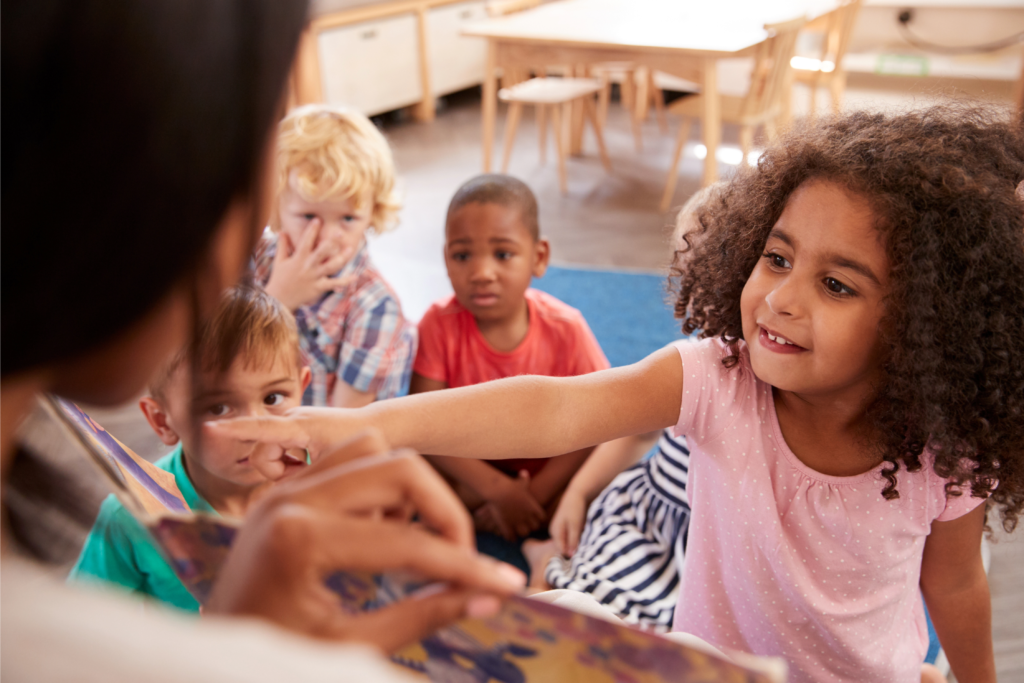
Success in reading often requires understanding “academic vocabulary.” This includes domain-general words related to high-level concepts—such as causal explanations, judgments, and predictive inferences—as well as domain-specific technical terms for subjects like science and history. In preschools, this is often taught through shared reading and calling out unfamiliar words related to the text. For instance, vocabulary learned from the book, “The Three Little Pigs” could include relevant “academic” words such as terrified, frustrated, and ruined.
In preschool, the more fun, engaging, and playful these word activities are for children, the more motivated and willing they will be in later grades to look up unfamiliar vocabulary words when they’re reading and apply their newfound knowledge of these “academic” words in their writing.
Incidental Learning vs. Direct Vocabulary Instruction
Incidental vocabulary learning happens through simple exposure to words. As children encounter words, they infer their meaning through context, interactions, experiences, and the environment. This shapes their understanding without any directed effort from the teacher or curriculum. Types of incidental word learning include shared book reading, multiple-turn conversations (Strive for 5, for example), and use of words during engaging activities (play centers, playground activity).
To increase a child’s recall and strengthen their understanding of words, early childhood educators can utilize direct vocabulary instruction, which asks a child to listen to word definitions and remember their meaning. This approach has real evidence behind it: Elley’s foundational study (1989) found that children learned about 25 percent more words when teachers directly explained word meanings during shared book reading, compared with simply hearing the words read aloud.
Since building vocabulary is incremental, teachers who provide opportunities to use these new words throughout the day help solidify their meaning and increase children’s vocabulary.
How Play Supports a Preschooler’s Vocabulary and Language Development
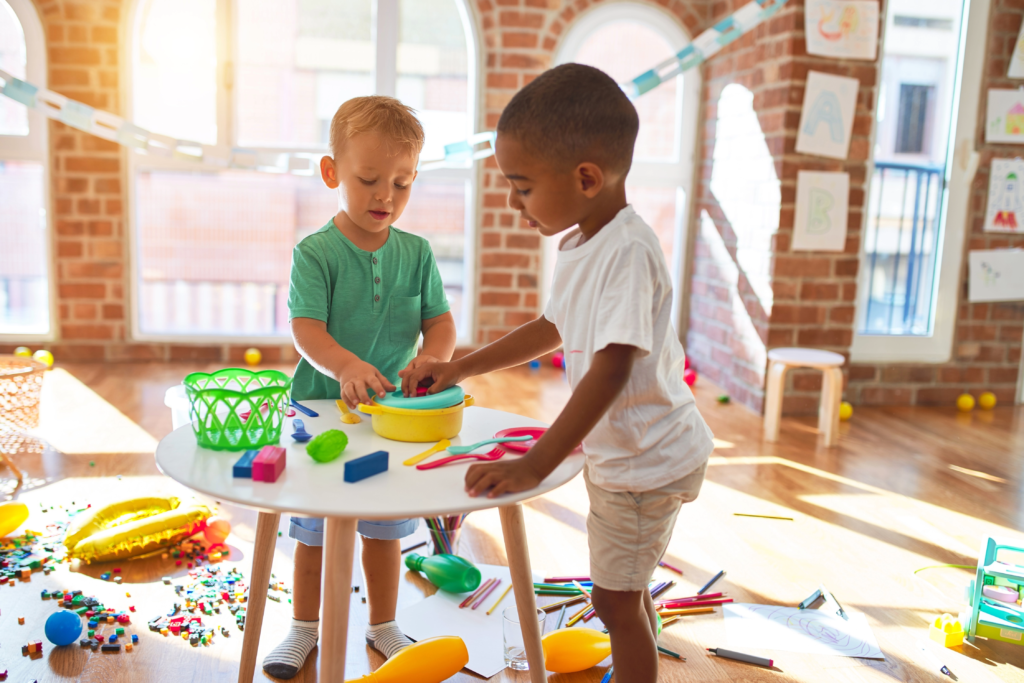
Play is a child’s work and a natural way for children to learn, practice, and expand their vocabulary. Pretend play, such as using a block to represent a car, or a banana as a phone, exercises the same symbolic thinking that allows children to understand that spoken sounds (words) represent real objects.
Children tend to talk more and use more elaborate language during rich and engaging play than they do in most other contexts. When playing with others, children will practice their communication skills to negotiate roles, narrate storylines, and resolve disagreements about game rules. Play helps deepen a child’s developing emotional vocabulary and develop a theory of mind, which is the recognition that others have different desires, beliefs, and bases of knowledge from their own.
Strategies to Support Early Childhood Vocabulary
Teachers can foster vocabulary learning throughout the day using a variety of methods, including:
Instructional Strategies
- Introduce new words and their definitions before shared reading to prepare children for the text.
- Intentionally teach words as they arise naturally within context, rather than in isolation.
- Use multisyllabic and sophisticated words repeatedly so children can master their use.
- Introduce diverse types of words, including actions (gallop, soar) and attributes (enormous, miniscule).
- Provide multiple opportunities for children to use their newly learned words in different contexts throughout the classroom.
- Clarify or explain unfamiliar words by relating them to familiar, everyday objects or actions.
- Notice what children are looking at and describe their focus using interesting, rich vocabulary.
Daily Routines and Discussions
- Utilize morning meetings as an opportunity to engage children in rich conversations about upcoming activities and the materials they’ll use.
- Ask open-ended questions during story time and ensure all children have an opportunity to share their thoughts.
- Review morning activities and allow children to share their interests during lunchtime.
- Incorporate language learning into transitions, such as using spatial directions (front, back, next to, or behind) when children are lining up.
- Encourage children to talk, share ideas, and engage in lively conversations throughout the day.
Interactive Activities and Games
- Play sorting games to help children notice similarities and differences and build an understanding of categories. Invite children to sort familiar objects such as shapes, foods, toys, or natural materials, and invite them to explain how they decided where each item belongs. Reinforce categories by having children identify which item in a group is different (e.g., picking an airplane out of a group of animals) and encouraging them to explain their thinking.
- Respond promptly when a child initiates a conversation, using it as an opportunity for language practice by commenting, asking a follow-up question, or introducing new vocabulary.
Environmental and Linguistic Supports
- Create a language-rich environment where children have frequent opportunities to talk, share ideas and feelings, ask questions, and engage in back-and-forth conversations with adults and peers.
- Affirm and incorporate children’s identity and learning by inviting children to use the languages they know to communicate, share ideas, and make connections to their experiences. Include home and tribal languages in labels, signs, books, posters, songs, and other classroom materials.
- Use photographs, graphics, and other visuals alongside words to help children connect language to familiar people, objects, actions, and experiences.
Children are naturally driven to understand the world around them by asking questions, sharing ideas, making connections, and using language to make sense of their experiences. Educators can nurture this innate curiosity and encourage the joy of learning by creating playful, engaging opportunities for children to hear, explore, and use new words throughout the day. When children have meaningful reasons to communicate, new vocabulary becomes part of how they understand, express, and connect with the world around them.
Resources:
Going Nuts for Words: Recommendations for Teaching Young Students Academic Vocabulary
Vocabulary Acquisition from Listening to Stories
HeadStart Effective Practice Guides
Cognitive and Language Development: Unraveling the Intricate Connection
Explicit Vocabulary Instruction to Build Fair Access for All Learners
Early Childhood Solutions
We offer an array of flexible, developmentally appropriate, and play-rich early childhood learning solutions to meet your unique needs.
Related Reading:
Developing The Big 5 Series: