
This is the second in a series of blogs based on the findings of the National Early Literacy Panel (NELP) (2002), and the instructional practices that best support emergent literacy in children ages 0–5. Their report, Developing Early Literacy (2008), identified a set of foundational abilities developed in the preschool years that strongly predict later reading success.
These abilities became known as the Big 5 Early Literacy Skills:
- Oral language
- Phonological awareness
- Print concepts
- Alphabetic principle
- Vocabulary and meaning
Our first blog discussed oral language. Below we take a close look at phonological awareness.
What Is Phonological Awareness?
Across our world, there are over 7,000 languages, and each language contains a multitude of individual sounds and structures that comprise its words. Phonological awareness is the ability to hear and process those individual sounds and structures.
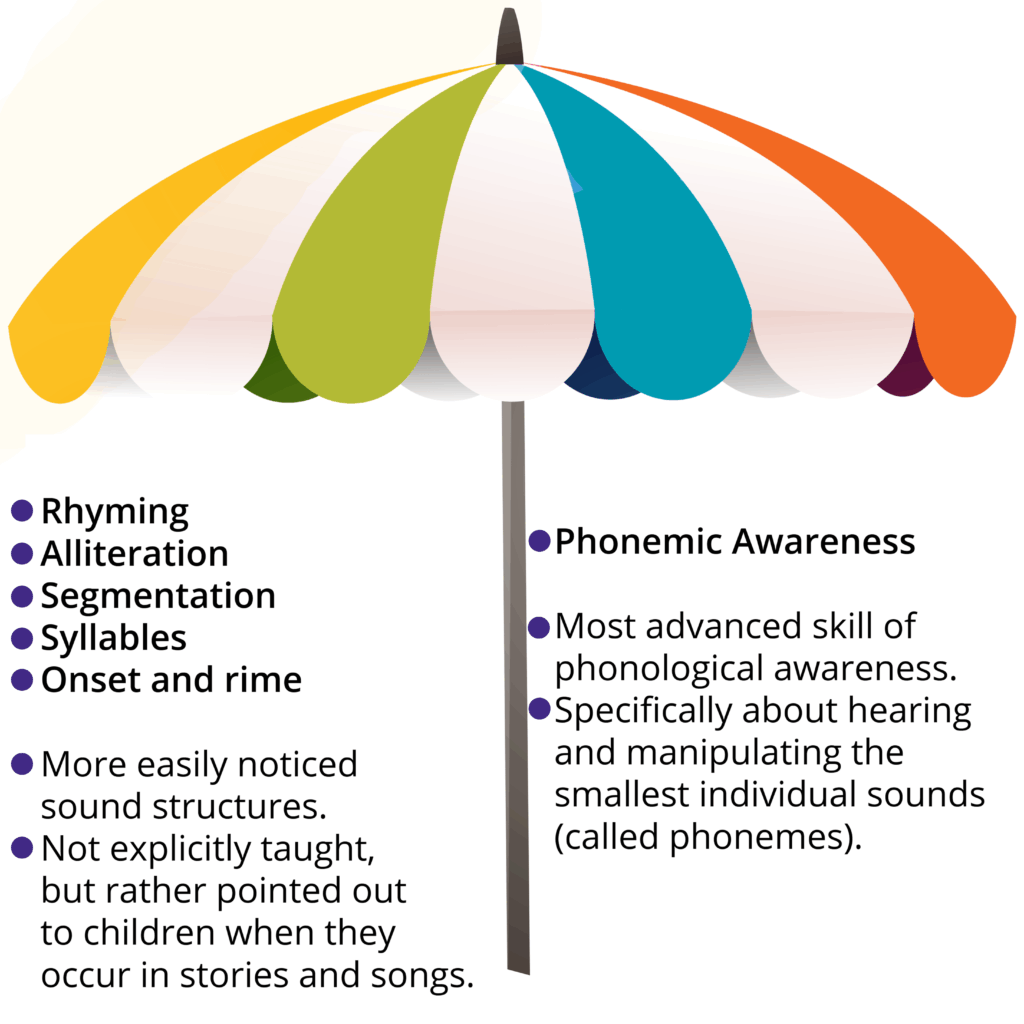
We can illustrate phonological awareness as an umbrella sheltering a number of skills:
- rhyming
- alliteration
- sentence segmentation
- syllables
- onset and rime
- phonemic awareness
The final item in this list is phonemic awareness—the ability to hear, identify, and manipulate the individual, smallest sounds (phonemes) in spoken words—and it is the most advanced skill within the umbrella category of phonological awareness.
The Role of Phonological Awareness in Pre-K Instruction
The National Early Literacy Panel (2008) reviewed nearly 70 studies showing that phonological awareness was a strong predictor of later reading achievement.
Therefore, instruction in phonological awareness is an important focus in Pre-K; it helps children develop the phonemic awareness needed to engage in the phonics instruction that occurs in grades K–2. (Phonics instruction helps students establish connections between letters, or graphemes, and their corresponding sounds, or phonemes. )
Carefully coordinating the teaching of both phonological awareness and phonics can ensure that students make maximum progress in reading.
What Does Phonological Awareness Do?
Phonological awareness builds a shelf in the brain for students to attach letters to during phonics instruction.—David Kilpatrick, Ph.D., Equipped for Reading Success
The ability to perceive the individual language sounds within words is essential to developing a solid understanding of decoding and later, reading.
Being proficient in phonological awareness’s most advanced skill, phonemic awareness, allows children to make clear connections between sounds and letter patterns.
Each individual component of phonological awareness serves a purpose.
Rhyming
What it is: The repetition of sounds at the end of words. Starting from the vowel sound through all of the ending consonant sounds, words rhyme when they share the same ending sounds, such as cat, hat and bat.
Why it’s important: Rhyming is often the earliest indicator that a child is tuning into the sound structure of language.
Alliteration
What it is: The occurrence of the same sound at the start of words, for instance, “baby bear blows blue bubbles” or “dainty dinosaurs dig disco dancing.”
Why it’s important: Recognizing alliteration helps children focus on the beginning sounds of words, a critical skill for later phonics learning. It trains young ears to pay attention to word beginnings.
Sentence segmentation
What it is: Breaking sentences into individual words that can be counted and separated.
Why it’s important: This skill helps children understand that language has structure. They learn that the stream of speech they hear actually contains separate meaningful units—words.
Syllable segmentation and blending
What it is: Breaking words into their individual syllable parts and combining syllables to make a word.
Why it’s important: Syllable awareness skills aid children in reading and writing with segmenting and blending activities. Segmenting skills aid in spelling as students must first segment a word into individual sounds and then write the letters that correspond to the sounds. Syllable blending activities require students to hear multiple syllables, then blend them to create a word (Learning Differentiated, n.d.).
Onset and rime
What it is: Separating words into two parts—the initial consonant sound called the ‘onset’ and everything else called the ‘rime.’ For example, in ‘fan,’ /f/ is the onset and /an/ is the rime.
Why it’s important: This skill is a critical bridge between syllable awareness and full phonemic awareness. It helps children understand that words can be broken into meaningful sound chunks.
Phonemic Awareness
What it is: The most advanced level—identifying and manipulating the individual sounds (phonemes) in words. This is where your child learns that cat has three separate sounds: /c/, /a/, and /t/.
Why it’s important: Phonemic awareness directly connects to decoding and spelling. When children can hear individual sounds in words, they’re ready to start learning which letters represent those sounds.
How To Support Children’s Development of Phonological Awareness
Being able to discriminate between different sounds heard in the environment helps children tune in and become aware of sound. It also helps develop their listening and attention skills, which are crucial for learning and reading.
Phonological awareness is a purely auditory practice that begins with developing listening skills. There are several ways to support children’s development in this area:
Targeting environmental sounds
How it’s done: Moving outside and listening for the unique sounds within the immediate outdoor environment. Inside games in which children guess a sound are effective as well and provide almost infinite ways to engage listening skills.
Sentence segmentation
How it’s done: Counting words on fingers as they are recited in familiar sentences. For example, as the educator says “It’s time for lunch,” they count the words on their fingers.
Syllable awareness
How it’s done: Clapping, hopping, stomping at each syllable of a word. Musical instruments (drums, tambourines, rhythm sticks) can be used as children hit them for each syllable.
Phonemic awareness
How it’s done: Calling attention to the smallest units of sounds in familiar words, such as pointing out two names that start with the same sound or telling the children, “It’s cold outside. We will all need to wear something on our heads that starts with /h/” (Gritt & Standish, 2024).
Why Phonological Awareness Is Important
Phonological awareness, including each sub-element under its umbrella, builds auditory discrimination while providing practice that leads to automaticity, providing children the ability to expressively identify sounds and sound combinations over time.
Phonological awareness is a precursor for phonics instruction, setting the stage for decoding, blending, and, ultimately, word reading. It is essential for kindergarten readiness.
Resources:
Gritt, A., & Standish, K. (2024, Winter). Word play throughout the day: Phonological awareness in the preschool classroom. Teaching Young Children, 17(2). https://www.naeyc.org/resources/pubs/tyc/winter2024/word-play-throughout-the-day
Kilpatrick, D. A. (2016). Equipped for reading success: A comprehensive, step-by-step program for developing phoneme awareness and fluent word recognition. Casey & Kirsch Publishers
Learning Differentiated. (n.d.). The importance of syllable awareness. https://learningdifferentiated.com/the-importance-of-syllable-awareness/
Shanahan, T. (2016, March 28). What phonological awareness skill should we be screening? Shanahan on Literacy. https://www.shanahanonliteracy.com/blog/what-phonological-awareness-skill-should-we-be-screening
Related:
Developing the Big 5 Early Literacy Skills: Oral Language
Early Childhood Strategies to Support Oral Language and Vocabulary
Play vs. Learning: A False Dichotomy in Early Childhood Education
Early Childhood Solutions from Collaborative Classroom
No two classrooms are the same—that’s why we offer an array of flexible, developmentally appropriate, and play-rich early childhood learning solutions to meet your unique needs.