
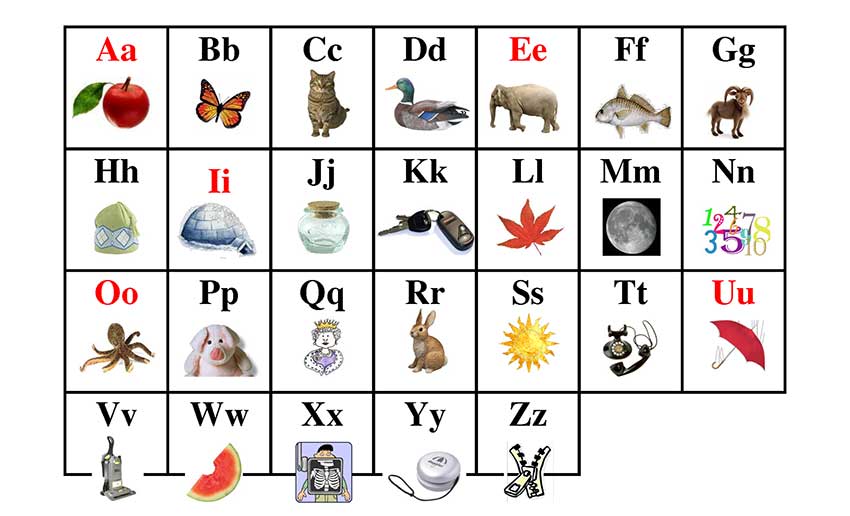
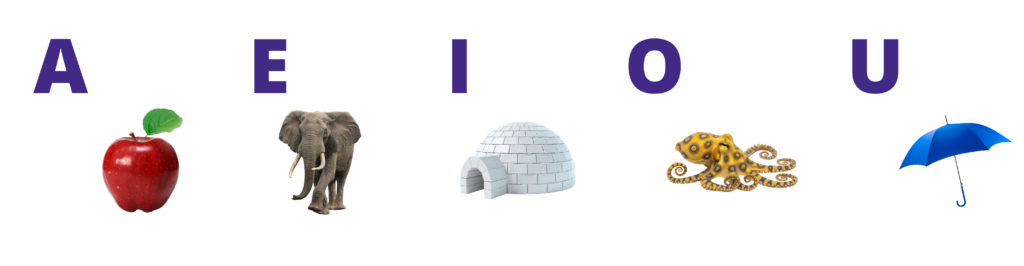
If you walk into almost any early elementary classroom, you’ll see a phonics chart that looks nearly identical to the ones we used decades ago. For the short vowel sounds, the anchors are highly predictable: A is for apple, E is for elephant, I is for igloo, O is for octopus, and U is for umbrella.
While these classic key words successfully isolate the short vowel sounds within a closed-syllable word structure, they miss a profound instructional opportunity. They treat phonics purely as a decoding mechanism, isolated from syntax, oral language development, and real-world utility.
Beyond the Apple: How Dr. John Shefelbine Reimagined Short Vowels to Build Sentences and Oral Language
The late Dr. John Shefelbine, renowned reading expert and developer of the SIPPS program, saw a better way. He recognized that for young readers—and particularly for multilingual learners—every second of instructional time must be leveraged for both decoding power and linguistic growth.
His solution? A beautiful, simple, and utterly unique approach to teaching short vowels that uses a cat, a chair, and the power of complete sentences.
The Initial-Position Advantage
Many conventional reading programs introduce short vowels in the middle of a word (the medial position), such as /a/ in lamb or cat, or they have those earlier examples such as apple, elephant, igloo. However, isolating a short vowel sound in the middle of a consonant-vowel-consonant (CVC) word can be aurally challenging for a novice reader.
Dr. Shefelbine bypassed this initial hurdle by choosing anchor words where the short vowel sits at the beginning of the word (the initial position). When launching the word with the target phoneme, the vowel sound is clean, crisp, unadulterated by a preceding consonant, and far easier for an emerging reader to segment and isolate.
But he didn’t stop at phonetic positioning. He carefully selected words that double as critical Tier 1 spatial function words—prepositions and nouns that dictate the geometry of our language.
The Story of a Cat and a Chair
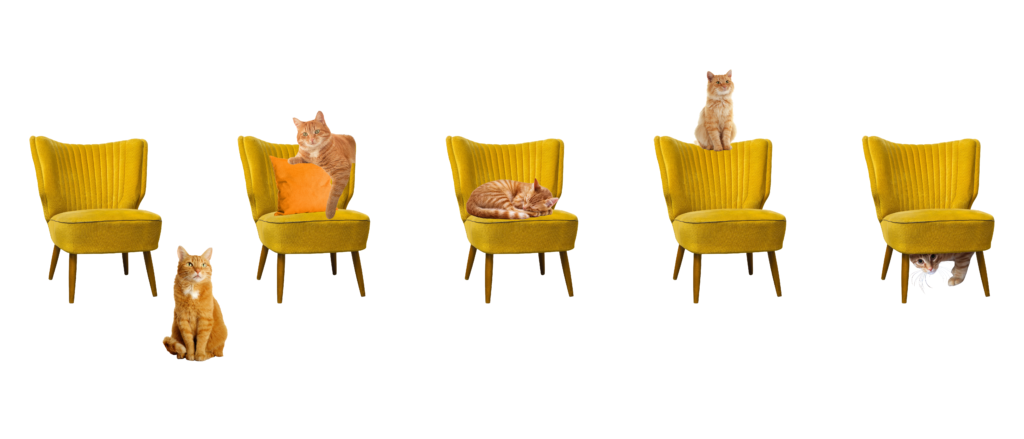
Instead of five unrelated nouns (apple, elephant, igloo, octopus, umbrella), Dr. Shefelbine unified the short vowels into a singular, memorable visual narrative. Every short-vowel mnemonic features two constant elements: a cat and a chair.
By anchoring the spatial relationship between the cat and the chair, he created a concrete, contextual framework for all five short vowel sounds:
| Vowel | Anchor Word | Spatial Placement | The Full-Sentence Mnemonic |
| /a/ | at | The cat is positioning itself near the furniture. | “The cat is at the chair.” |
| /e/ | edge | The cat is balancing on the very side of the cushion. | “The cat is at the edge of the chair.” |
| /i/ | in | The cat is nestled in the seat. | “The cat is in the chair.” |
| /o/ | on | The cat is perched on top of the chair back. | “The cat is on the chair.” |
| /u/ | under | The cat is hiding beneath the chair. | “The cat is under the chair.” |
The Multilayered Impact of Dr. Shefelbine’s Technique
This shifts phonics instruction from mechanical drilling to dynamic language acquisition. By tying the short vowel sounds to these precise prepositions and complete sentences, Dr. Shefelbine’s method delivers three massive instructional wins simultaneously:
It Builds High-Frequency Function Language Immediately
Words like at, edge, in, on, and under are essential and useful high-frequency function words. They are the mortar that holds the bricks of our sentences together. Instead of waiting for these words to appear later as memorized “sight words,” students internalize them on day one as phonetically regular entry points to literacy.
It Models Complex Syntax and Sentence Structure
When a student learns the sound for short /o/, they aren’t just bark-reading the isolated word on. They’re practicing and speaking a complete, syntactically correct sentence: “The cat is on the chair.” This repetitive, structured exposure models foundational English syntax early on, providing students with an implicit understanding of noun-verb-preposition-noun construction.
It Serves as an Essential Bridge for Multilingual Learners
For English Language Learners (ELLs) and students working hard to expand their oral language ecosystem, spatial prepositions can be notoriously difficult to master. Shefelbine’s cat-and-chair framework provides an instant, vivid visual anchor for these abstract spatial concepts. Not only are they learning how to decode print; they’re building the precise oral language infrastructure required for listening and reading comprehension.
A Legacy of Efficiency
Dr. Shefelbine’s genius lay in his deep understanding of instructional efficiency. He knew that reading isn’t merely the sum of isolated sub-skills, but the orchestration of phonology, orthography, and semantics working in harmony. By replacing the apple with the cat at the chair, he gave teachers a tool to teach phonics, vocabulary, syntax, and comprehension in a single, elegant brushstroke. It remains a master class in reading instruction design—proving that when we teach a child to decode, we can simultaneously give them the language to describe their world.
Note: The same technique for learning the letter sounds is built into Being a Reader. Because students master both decoding and encoding, this technique facilitates strong sentence writing in Being a Writer. Together, these make up Collaborative Literacy.
About the Author

Linda Diamond is Executive Director of the Evidence Advocacy Center and Co-Author of the Teaching Reading Sourcebook. Linda has dedicated her career to teaching children to read, particularly those with word reading difficulties like dyslexia.
A long-time partner of Collaborative Classroom, Linda co-founded CORE Learning alongside former California Superintendent of Public Instruction Bill Honig in 1995. After serving as CORE’s president for 26 years, Linda stepped down from that role in December 2020 while continuing to serve on CORE’s Advisory Board.
Related:
Why Are So Many States Recommending SIPPS?
Can a Curriculum Support the Science of Reading and Science of Learning?
SIPPS 5th Edition
Learn More About SIPPS by Downloading Our Digital Sample Kit