Support for English Learners, Built Into Our Curriculum
Being a Reader™, the reading component of Collaborative Literacy, includes a powerful Designated English Language Development (D-ELD) component designed to help English Learner–identified students develop the language, literacy, and academic knowledge they need to fully engage in grade-level instruction.
Unlike isolated language programs, Being a Reader’s D-ELD component gives students explicit language instruction while keeping them engaged in rich, grade-level literacy and content learning. Students have meaningful opportunities to examine how English works, develop academic language, and apply what they learn in authentic contexts.


Designated ELD should not be seen as an additional comprehension lesson. It’s dedicated time to develop English language proficiency using the rich academic language students are already encountering in their tier one literacy instruction.
George Ellis, Director, California Reading & Literature Project (CRLP), UC Berkeley

It’s doing a disservice to children when you don’t provide them the opportunity to engage with complex texts, because the complex texts are where all the great language is. It’s really hard to develop language when you don’t give children the source that has language in it.
Dr. Pamela Spycher, Researcher and Expert in Multilingual Learner Education
Our Approach to Designated ELD
Amplify language. Connect to learning. Build on what students bring.
Being a Reader’s D-ELD component creates intentional opportunities for students to develop language as they engage with meaningful, grade-level learning. The support helps educators:
Connect Text to Grade-Level Learning
Use the same grade-level texts as core literacy instruction, so students develop language while engaging with meaningful academic content.
Make Language Visible
Explicitly teach the vocabulary, sentence structures, and academic discourse embedded in grade-level texts.
Build Around Student Talk
Give students frequent opportunities to discuss, collaborate, explain, and use language to make meaning.
Build on Student Assets
Build on students’ languages, cultures, experiences, and knowledge as assets for learning and participation.

What Our D-ELD Component Looks Like in Practice
The D-ELD component is designed to be practical, flexible, and easy to integrate into the school day.
Designed to Fit Into the School Day
- 30 additional minutes of daily instruction aligned with Being a Reader read-alouds and lessons
- Flexible implementation by classroom teachers, support staff, or specialists
Resources to Support Implementation
It provides the tools teachers need to deliver consistent, connected language instruction.
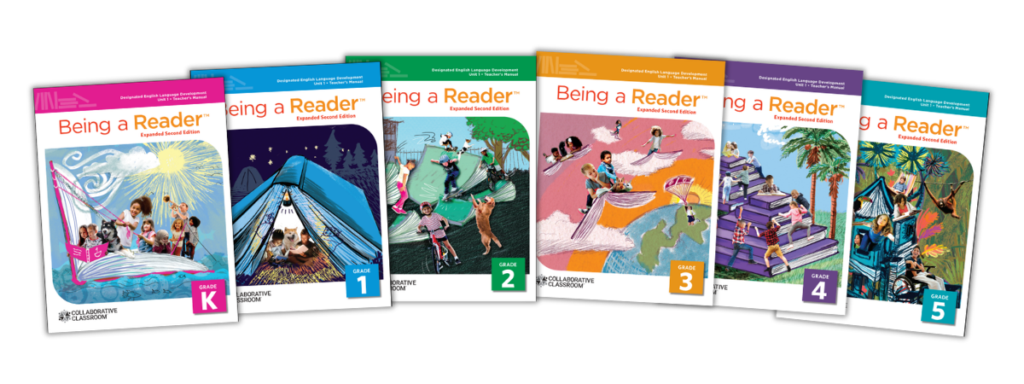
- Digital D-ELD Teacher’s Manuals: D-ELD Teacher’s Manuals are available digitally through the Learning Portal
- Language Notebooks: Print notebooks for every student to support language analysis, practice, and application
- Assessment Resources: Tools to help teachers monitor students’ language development and progress
- Family Support: Resources that help families understand and support students’ language development
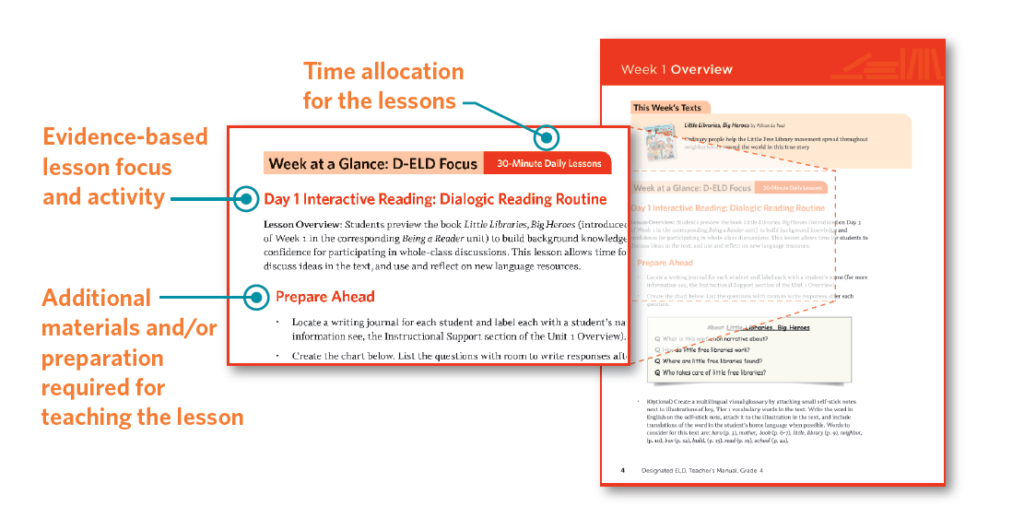
Teachers:
- Build from core instruction: Connect language learning to the texts, topics, and ideas students are encountering in Being a Reader.
- Model and explain: Explicitly teach vocabulary, sentence structures, and language patterns students need to understand and express ideas.
- Model and guide: Provide clear examples and scaffolded practice before students use new language independently.
- Create opportunities for talk: Structure purposeful partner and group interactions where students practice academic language.
- Connect language to meaning: Help students apply new language as they read, discuss, write, and make meaning from grade-level content.
Students:
- Explore language in context: Examine vocabulary, sentences, and discourse from grade-level texts through activities such as sentence unpacking and text reconstruction.
- Practice new language: Use academic language through structured speaking, reading, and writing activities.
- Collaborate and communicate: Listen, respond, build on ideas, and express their own thinking through purposeful academic conversations.
- Make meaning from language: Connect new vocabulary and language structures to the content they are learning.
- Apply what they learn: Use new language skills to engage with grade-level literacy content.

Built for California’s Vision of English Language Development. Designed for English Learners Everywhere.
Being a Reader’s D-ELD component was developed with guidance from California-based experts in English language development and literacy, including Dr. Pamela Spycher, a primary author of the California ELA/ELD Framework and ELD Standards; Dr. Marianne Justus, former senior research associate at WestEd; and George Ellis, Director of the California Reading & Literature Project at UC Berkeley.
The D-ELD component is grounded in the rigorous, integrated vision of English Language Development reflected in California’s ELA/ELD Framework and Standards—an approach we believe can benefit English Learners nationwide.

Its instruction centers on five priority areas:
- Meaning Making: Students build knowledge and strengthen comprehension through collaborative, interactive reading and writing.
- Language Development: Students develop academic language through vocabulary, language analysis, sentence unpacking, and text reconstruction.
- Effective Expression: Students develop oral and written communication through discussions, presentations, performances, and creative activities.
- Content Knowledge: Students use the same grade-level literary and informational texts from core instruction to develop both content knowledge and academic language.
- Foundational Skills: Students strengthen phonics, print awareness, morphology, fluency, and automaticity through reading and oral language activities.
Together, these priorities support English proficiency, language development, and meaningful engagement with grade-level learning—principles that extend well beyond California.
In my opinion, this is one of the few ELD programs that truly reflects the vision of the California ELA/ELD Framework by maintaining intellectual richness while positioning students’ language, culture, and experiences as assets to build on rather than deficits to remediate.
UC Berkeley’s George Ellis