
This is the second article in a series based on the findings of the National Early Literacy Panel (2002) and the instructional practices that best support emergent literacy in children from birth to 5 years old. The panel’s report, Developing Early Literacy (2008), identified a set of foundational abilities developed in the preschool years that strongly predict later reading success.
The SEEDS of Learning Professional Learning Framework for 3–5-year-olds created the Big 5 Early Literacy Skills based on the 11 literacy-related variables that consistently predict conventional literacy outcomes. The relationship between these variables and their positive outcomes is significant, highly reliable, and stable.
For memory and ease of recall, the 11 variables have been combined into the “Big 5” early literacy predictors:
- Oral language
- Phonological awareness
- Print concepts
- Alphabetic principle
- Vocabulary and meaning
Our first article discussed oral language. Below we take a close look at phonological awareness and share important updates from the growing body of science of reading research that is refining how we should teach it.
What Is Phonological Awareness?
Across our world, there are more than 7,000 languages, and each language contains a multitude of individual sounds and structures that make up its words. Phonological awareness is the ability to hear and process those individual sounds and structures.
Phonological awareness has traditionally been illustrated as an umbrella covering a number of skills, from broader sound structures to the most detailed level of individual sounds:
- Rhyming
- Alliteration
- Sentence segmentation
- Syllables
- Onset and rime
- Phoneme awareness(the most advanced skill)
Phoneme awareness—the ability to hear, identify, and manipulate the individual, smallest sounds (phonemes) in spoken words—is the most advanced skill within the category of phonological awareness.
Important Research Update
Research has evolved significantly on how these skills relate to one another. The traditional view held that children must master rhyming, syllables, and onset-rime awareness before they can develop phoneme awareness (the so-called “large to small” sequence). However, current evidence does not support this view. Children do not need to master broader phonological sensitivity skills in order to attain phoneme awareness. As literacy researcher Dr. Susan Brady notes, phonological sensitivity instruction (with larger units such as rhyme, syllables, and onset-rime) is “neither a prerequisite nor a causal factor in the development of phonemic awareness.”
This has practical implications for PreK and kindergarten instruction: spending significant time on rhyming, syllable segmentation, and similar activities as a prerequisite to phoneme work may delay the instruction children most need.
A Clarification in Terminology
Because the field has refined its understanding, it is now helpful to use more precise language:
Phonological sensitivity refers to awareness of the larger sound structures in speech—rhymes, syllables, onsets, and rimes. These are sometimes more easily noticed but are not the critical path to reading success.
Phoneme awareness (or phonemic awareness) is the ability to consciously think about and manipulate the individual speech sounds (phonemes) in spoken words. This is the skill directly tied to decoding and spelling, and it is where instructional focus should be concentrated.
Using this distinction helps avoid misunderstandings when designing instruction and interpreting assessments.
What Does Phoneme Awareness Do?
“Phonemic awareness is what allows us to anchor the sounds in a word to the written sequence of letters that represent those sounds.”
—David Kilpatrick, Ph.D., Essentials of Assessing, Preventing, and Overcoming Reading Difficulties
The ability to perceive the individual language sounds within words is essential for developing a solid understanding of decoding and, later, reading. Being proficient in phoneme awareness allows children to make clear connections between sounds and letter patterns (graphemes).
Importantly, current research demonstrates that phoneme awareness instruction is most powerful when it is linked with letters from the very beginning—not taught as a purely oral, auditory skill in isolation. Two recent meta-analyses confirm this:
- Phoneme Awareness-only instruction (without letters) improves reading-related skills more than no instruction, but is less effective than instruction that links phonemes with their corresponding graphemes from the start.
- Incorporating graphemes into phoneme awareness activities accelerates reading acquisition for beginning readers and for students who struggle at any age.
How Phoneme Awareness Develops: The Right Sequence
Phoneme awareness develops gradually, most often as children are learning to read and spell. The location of a phoneme in a word influences how easily children become aware of it. Research points to a clear developmental progression.
Beginning Phoneme Awareness
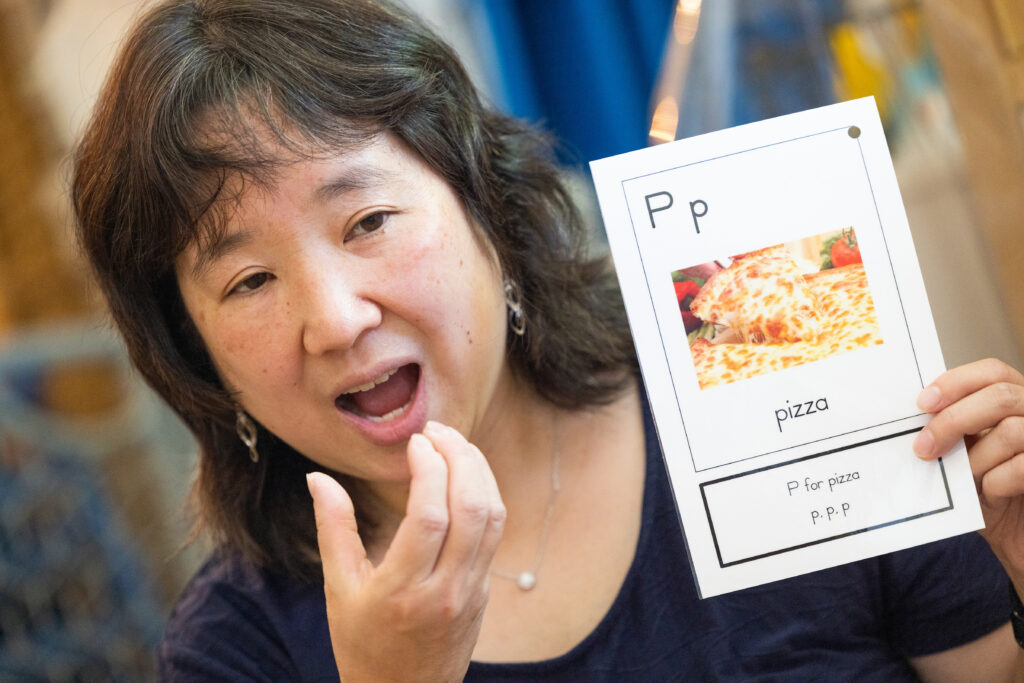
Start with initial phonemes—the first sound in a spoken word without a blend at the beginning (e.g., CVC words like cat, map, fun). This is the easiest position for beginners.
Children’s names are a natural and motivating starting point: “What is the first sound in Sam? It’s /s/! And here is the letter that stands for /s/.”
Once children have solid awareness of initial phonemes across a variety of sounds, move to final phonemes in one-syllable CVC words, and then to the medial vowel (the middle sound).
Later Phoneme Awareness
After mastering phonemes in simple syllables (CVC words), students are ready for complex syllables—words that include consonant blends (e.g., clap, felt, crisp, splash). The internal consonants within blends are the most challenging to isolate and are a common source of spelling and reading errors.
Teaching Tip: Watch for spelling errors that omit a sound—they are a diagnostic window into a student’s phoneme awareness. Spelling bed as “bd” often reflects lack of awareness of the medial vowel. Spelling plan as “pan” suggests the student cannot yet isolate the /l/ in the blend.
Instructional Goals by Grade
PreK: Begin working on initial phoneme awareness and link each sound to its corresponding letter. Nursery rhymes and songs can be fun but do not need to be a formal prerequisite. Focus on first sounds—especially in children’s own names.
Kindergarten: Full acquisition of beginning phoneme awareness (initial, final, and medial phonemes in simple CVC syllables) is a realistic goal, coordinated with letter names, letter sounds, and handwriting instruction.
First Grade: Once simple-syllable phoneme awareness is confirmed, advance to awareness of phonemes in complex syllables with consonant blends.
Beyond First Grade: Students who have not attained full phoneme awareness need targeted intervention, beginning with assessment to identify precisely where their awareness development has stalled.
Why Linking Phonemes with Letters Matters
One of the most significant shifts in current understanding is that phoneme awareness instruction should not be conducted as an oral-only activity—at least not for phoneme manipulation tasks (addition, substitution, deletion).
Here is why: when good readers are asked to mentally manipulate phonemes in spoken words, they automatically draw on their knowledge of how those words are spelled. The oral manipulation skills seen in skilled readers are largely a consequence of their reading development, not a prerequisite. Requiring struggling readers to do complex phoneme manipulation without letters creates an unnecessary burden on working memory and may not build the skills they actually need.
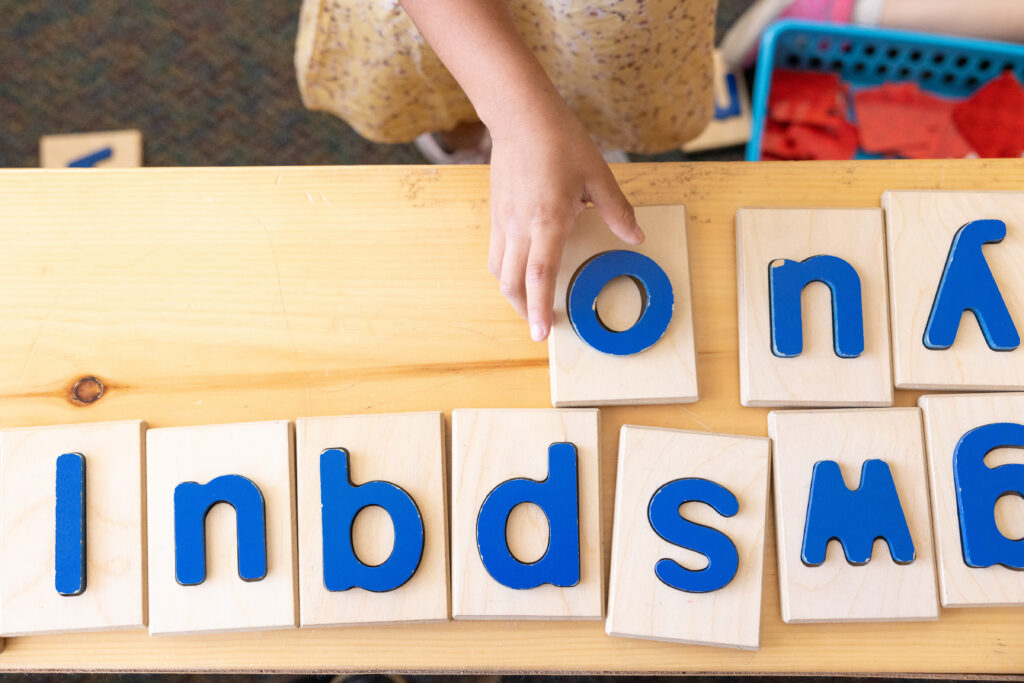
Instead, provide letter tiles or written letters during phoneme manipulation activities. This supports phoneme awareness and simultaneously builds the letter–sound links needed for orthographic mapping, the process by which spellings of words become stored in long-term memory for instant recognition.
Note: Oral tasks like isolation (“What is the first sound in ‘cat’?”), blending (/b/ /æ/ /t/ → “bat”), and segmentation (“cat” → /k/ /æ/ /t/) remain appropriate without letters, especially early in instruction. It is the more complex manipulation tasks—addition, substitution, deletion—that benefit from incorporating physical letters or letter tiles.
Handwriting practice coordinated with the grapheme-phoneme relationships being learned further strengthens these connections and lays a foundation for writing fluency.
Read Part 2 of this 2-part article
Resources:
Brady, S. (2020). A 2020 perspective on research findings on alphabetics (phoneme awareness and phonics): Implications for instruction. The Reading League Journal, 1(3), 20–28.
Susan Brady webinar Q&A: Phoneme Awareness: How Knowledge About This Component of the Science of Reading Has Evolved. Reading Simplified. https://readingsimplified.com/susan-brady-phoneme-awareness/
Gritt, A., & Standish, K. (2024, Winter). Word play throughout the day: Phonological awareness in the preschool classroom. Teaching Young Children, 17(2). https://www.naeyc.org/resources/pubs/tyc/winter2024/word-play-throughout-the-day
International Dyslexia Association. (2022). Building phoneme awareness: Know what matters [Fact sheet].
Kilpatrick, D. A. (2015). Essentials of assessing, preventing, and overcoming reading difficulties. Hoboken, NJ: Wiley.
Rehfeld, D., Kirkpatrick, M., O’Guinn, N. & Renbarger, R. (2022). A meta-analysis of phonemic awareness instruction provided to children suspected of having a reading disability. Language, Speech, and Hearing Services in Schools, 53, 1177–1201.
Shanahan, T. (2016, March 28). What phonological awareness skill should we be screening? Shanahan on Literacy. https://www.shanahanonliteracy.com/blog/what-phonological-awareness-skill-should-we-be-screening
Related:
Developing the Big 5 Early Literacy Skills: Phonological Awareness—Part 2
Developing the Big 5 Early Literacy Skills: Oral Language
Early Childhood Strategies to Support Oral Language and Vocabulary
Play vs. Learning: A False Dichotomy in Early Childhood Education
Early Childhood Solutions from Collaborative Classroom
No two classrooms are the same—that’s why we offer an array of flexible, developmentally appropriate, and play-rich early childhood learning solutions to meet your unique needs.