
Literacy success depends on three sciences. Do you know all of them—and does your ELA instruction reflect them?
In this blog series based on our recent edWebinar, Dr. Paige Pullen and Linda Diamond invite educators to look beyond the science of reading to explore the Three-Sciences Framework. While the science of reading is vital, on its own it cannot create the conditions for durable literacy success.
In the first article, Dr. Pullen and Linda Diamond introduced the framework and explored literacy science. In the second, they explored learning science.
This third and final article focuses on instructional science and the importance of teaching to minimize cognitive load. It answers the question, What are the teaching practices and designs that most effectively and efficiently promote durable learning?
Integrating the Three Sciences
A comprehensive approach to literacy integrates the three sciences: literacy science, learning science, and instructional science. This approach cultivates curiosity while encouraging an open mindset regarding future research. Questions that will ideally continue to be asked are:
- Literacy science: What developmental pathways and instructional components lead to proficient reading, writing, and language use for all students, especially for students acquiring general American English or students with reading or language difficulties, or even advanced learners?
- Learning science: How do humans acquire, process, and retain knowledge?
- Instructional science: Which teaching practices and designs most effectively and efficiently promote durable learning?
What Is Instructional Science?
Instructional science tells us that how instruction is designed is critical to promoting lasting learning that leads to proficient reading, writing, and language use.
Instructional science provides the blueprint for how to teach: how to organize, sequence, and deliver content in ways that align with how students learn.
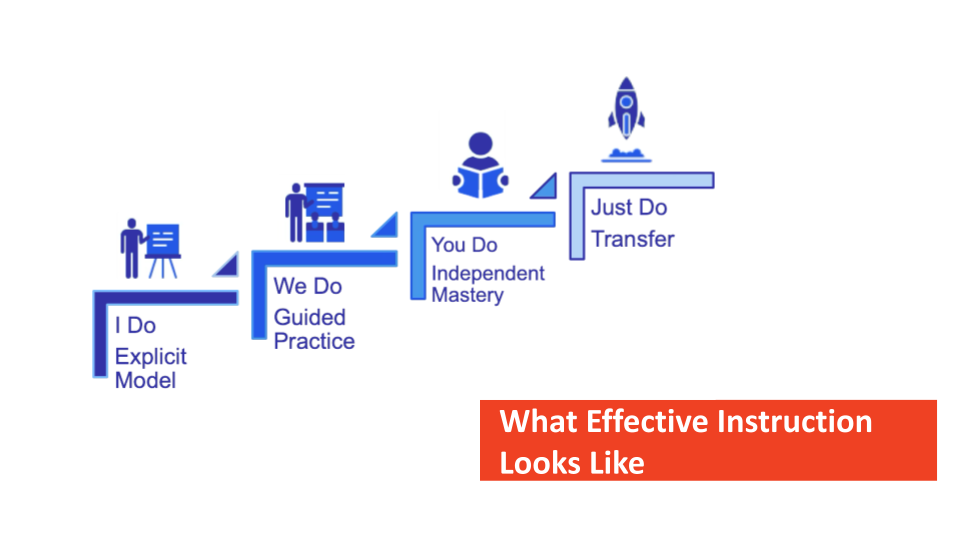
In the “I Do,” “We Do,” “You Do” model, educators use explicit modeling and guided practice to inculcate independent mastery. Moving beyond that model adds “Just Do,” which is where students are transferring the instruction and applying it in more challenging ways. Their ability to decode automatically, recognize more and more vocabulary meanings, read with fluency, and comprehend and enjoy text has therefore become less effortful and more efficient.
Dr. Barak Rosenshine, an educational researcher, synthesized findings from classroom studies, master teachers, and cognitive science to identify patterns of clear, effective instruction. His 10 Principles of Instruction support cognitive processing and the development of long-term memory through structured practice, frequent retrieval, and carefully sequenced learning.
Rosenshine’s 10 Principles of Instruction are:
- Begin a lesson with a short review of previous learning.
- Present new material in small steps with student practice after each step.
- Ask a large number of questions and check the responses of all students.
- Provide models.
- Guide student practice.
- Check for student understanding.
- Obtain a high success rate.
- Provide scaffolds for difficult tasks.
- Require and monitor independent practice.
- Engage students in weekly and monthly review.
How Do We Ensure Students Retain What Has Been Taught?
Retention is extremely important. If the principles of learning science are not considered, students may not retain what they have been taught in their long-term memory.
Starting with small steps, educators should use plenty of repetition and guided practice before students engage in independent practice. This is followed by immediate feedback. All of this should be included within the instructional design.
How Different Types of Practice Help Learning and Retention
Spaced, Retrieval, and Cumulative Practice
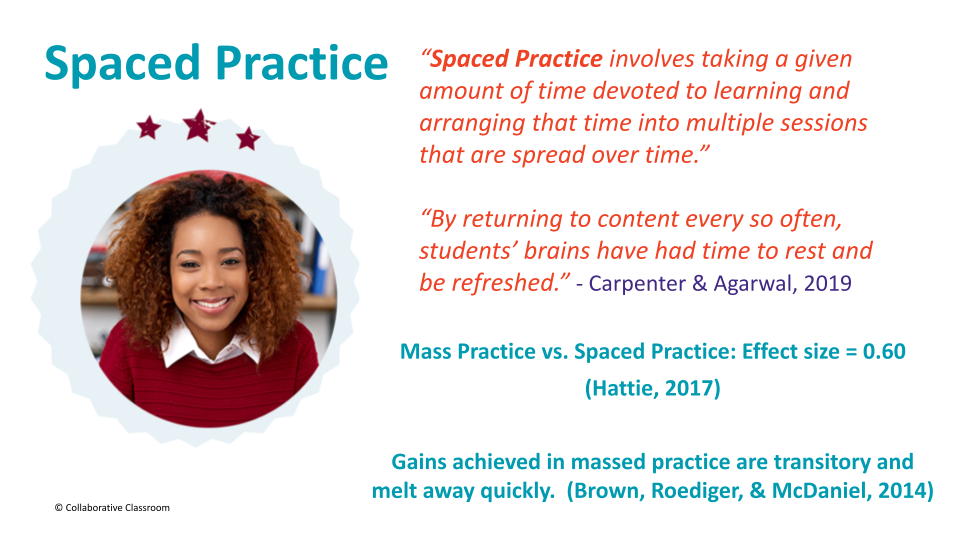
Spaced (or distributed) practice is learning that takes place over a period of time with rest periods between practice sessions.
Learning science tells us the importance of spacing, but how to ensure spacing is embedded in instructional science, and that is where design and delivery of instruction come in. With spacing, some period of time elapses before the same concept is taught again.
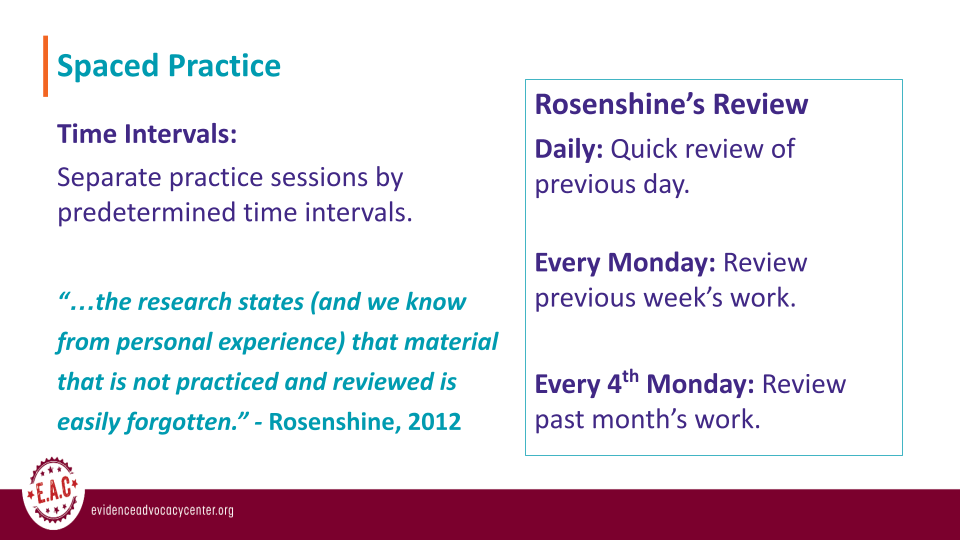
This is more powerful when combined with retrieval practice, where information is called to mind from memory.
Again, retrieval practice is explained in learning science, but how it is done is the link to instructional science. Rosenshine recommended and utilized quick daily reviews in his own classrooms: every Monday he reviewed the previous week’s work, and every fourth Monday he reviewed the entire past month.
Cumulative practice is taking the newly taught, related skill and adding it to the previously learned skills. While learning science provides the importance of cumulative or interleaved practice, how that practice manifests is where instructional science meets learning science.
These concepts are used in more areas than simply foundational skills. For example, teaching vocabulary:
Most Curricula Today Does Not Reflect Instructional Science
Quality, effective curricula should be developed according to Rosenshine’s core principles. Typically, however, this is not the case in most published commercial curricula:
- Many curriculum publishers are not using explicit and systematic instruction consistently.
- Nor are they including sufficient repeated practice, whether spaced, cumulative, or retrieval.
- Also they rarely build in sufficient engagement through questions, scaffolds for difficult tasks, immediate corrective feedback, or carefully designed modeling.
- Finally, sufficient retrieval practices from memory without cues are often left out.
What Educators Should Consider When Choosing Curricula
When reviewing and choosing instructional materials, districts and educators should consider the following questions:
- Does the curriculum contain sufficient explicit modeling?
- Is the curriculum sequenced systematically, not only for decoding instruction?
- Does the curriculum provide frequent opportunities for students to respond?
- Is there immediate, specific feedback to the student responses?
- Are these items included as guidance in the accompanying teacher manuals?
- Does the curriculum provide a substantial amount of opportunity for increased academic engagement?
- Is there sufficient, deliberate practice, including spaced, cumulative, and retrieval practice?
Ideally, all of these components are embedded in the curriculum design and delivery. A trusted resource, the 2026 Reading League’s curriculum evaluation guidance, contains a design and delivery section.
***
Sources:
How to Use Retrieval Practice to Improve Learning
Earlier Blogs in the Series:
Part 1: Why Literacy Success Depends on More Than the Science of Reading
Part 2: What Is Learning Science and Why Does It Matter for Literacy Success?
Related:
Why Sufficient, Deliberate Practice Is a Critical Element of Literacy Learning and Retention

Dr. Paige Pullen is an author and a cofounder as well as the Chief Learning Officer at Mindset CoPilot. A leading voice in literacy education, Dr. Pullen is committed to translating research into real-world impact. Through collaboration with educators, policymakers, and partners worldwide, she designs evidence-based solutions rooted in the science of reading—helping systems work better and ensuring every learner has the chance to succeed. An advisor to state literacy efforts, Dr. Pullen is leading the work on the Canon of Literacy for the Evidence Advocacy Center.
Linda Diamond is an author and the Executive Director of the Evidence Advocacy Center. Linda cofounded and became president of the Consortium on Reaching Excellence in Education (CORE Learning), an organization committed to improving literacy and math outcomes for all children. After serving as CORE’s president for 26 years, Linda stepped down from that role and continues to serve on CORE’s Advisory Board and The Reading League California Advisory Board, and advises publishers, state agencies, legislators, and other organizations as they work to improve literacy instruction.

Watch the Webinar
See how these three sciences intersect by accessing the on-demand webinar with Linda Diamond and Paige Pullen.