Literacy success depends on three sciences. Do you know all of them—and does your ELA instruction reflect them?
In this blog series based on our recent edWebinar, Dr. Paige Pullen and Linda Diamond invite educators to look beyond the science of reading to explore the Three-Sciences Framework. While the science of reading is vital, on its own it cannot create the conditions for durable literacy success.
In the first article, Dr. Pullen and Linda Diamond introduced the Three-Sciences Framework and the Canon of Literacy, and answered the question, What developmental pathways and instructional components lead to proficient reading, writing, and language use?
In this second article, they explore learning science and answer the question, How do humans acquire, process, and—of great importance—retain knowledge?
What Is Learning Science?
Learning science is interested in how people learn. It clarifies the understanding of how the brain selects, processes, stores, and retrieves information. It tells us how instruction should align to make sure that students are able to store what they are learning in long-term memory so that they can retain and retrieve it. Learning science (others refer to science of learning) is an applied, interdisciplinary field focused on how learning happens, directly applying cognitive science, neuroscience, and psychology to improve education.
While cognitive science broadly studies mental processes (thinking, memory), learning science specifically bridges lab-based findings with classroom strategies to maximize educational outcomes.
The Importance and Challenges of Working Memory
Working memory is limited in both capacity and duration. There are three parts:
- Extraneous load: Extra cognitive noise that may happen as part of instruction. Extraneous load describes working memory allocation that is not intrinsic to the task itself, but to how it is designed or the environment in which it takes place.
- Intrinsic load: Working memory allocation that deals with the task itself and is influenced by the complexity of the task itself.
- Germane load: An individual’s ability to process information and make the necessary connections. An individual manages a germane load whenever they explore a new skill, learn a new fact, or even have a new experience. Each individual creates their own avenues for remembering and accessing information they need.
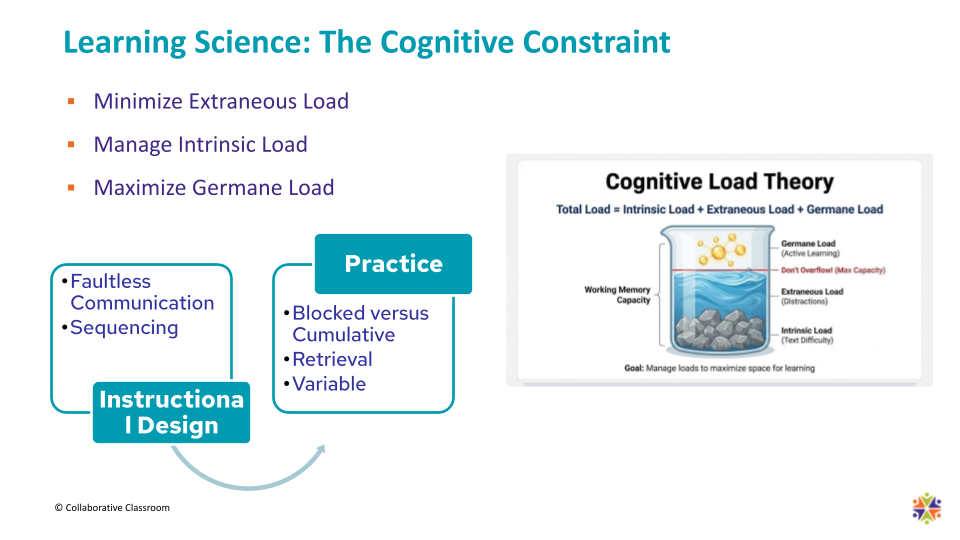
In this illustration, the rocks at the bottom of the beaker represent the intrinsic load, which is the difficulty of the task students are asked to do. Pouring water on top of that intrinsic load creates extraneous load, consisting of distractions such as overly complicated language.
Germane load is what is left when intrinsic and extraneous load are combined. Germane load is where children are able to process the information that results in learning.
The challenge is to minimize the cognitive noise (extraneous load) and manage the intrinsic load so that children are able to learn and remember what they have learned.
Two Ways to Manage Intrinsic Load and Minimize Extraneous Load
Instructional design and practice are two ways to manage intrinsic load and minimize extraneous load when teaching.
1. Instructional Design
Designing instruction so that it follows key instructional science practices will improve learning.
Faultless Communication
Faultless communication is communicating effectively without jargon and extra words, making it very clear and explicit for students. Brief, concise language and avoiding over-speaking both contribute to faultless communication.
Sequencing Instruction
Another part of instructional design is sequencing instruction. Sequencing involves making sure students have the prerequisite skills to complete the tasks they are asked to complete. Therefore, easier skills are taught before more difficult skills. High-need or high-frequency skills are taught before lower-frequency skills.
If students do not have the prerequisite knowledge to understand and absorb complex information, they are not likely to learn it. Communication and sequencing are two pieces of instructional design that help learning stick.
2. Practice
The other way to improve learning is through practice. There are several types of practice.
Block or massed practice is the act of practicing one thing repeatedly.
Cumulative or interleaved practice is where learning continues to build. Students practice previously learned skills and knowledge with newly taught but related skills and knowledge such as a mixed list of long vowels—newly learned “ea” as in team with previously learned “ee” as in need.
Retrieval practice is a strategy in which calling information to mind subsequently enhances and boosts learning. Deliberately recalling information forces students to pull knowledge “out” and examine what they know. It is precisely this “struggle” or challenge that improves memory and learning. In trying to recall information, memory is exercised and strengthened, and any gaps in learning can be identified.
Varied practice ensures students are not simply memorizing but using information flexibly. A variety of strategies can help implement frequent retrieval practice: clickers, index cards, bell work, quizzes, or quick writing prompts.
How Can We Reduce Cognitive Load?
Adequate support is essential to reducing cognitive load. This support might take the shape of providing explicit instruction using clear language and ensuring that targeted instruction is well-planned and very deliberate.
There is a limit to how long something new can be held in short-term working memory. Breaking information into meaningful chunks prevents a bottleneck of too much information. Providing appropriate practice also reduces cognitive load.
Novices versus Experts
Novices and experts are different and the way instruction is provided to each will differ.
Novice readers need to decode every word at first. They are required to focus on orthography and phonology because they have not yet stored words in long-term memory. For many years, educators believed the three-cueing system to be correct because it provided context, i.e., a word and accompanying picture.
Expert readers already have the orthography, phonology, and meaning of words stored in long-term memory. This means, for instance, that when they are choosing between two words that are spelled the same but mean different things, they are able to discern the appropriate meaning.
It is important to remember that novices do not have the same knowledge as experts. As expert readers, educators sometimes inadvertently ask their students to use context to decode words. They were skipping the orthography-and-phonology combination, that is, grapheme-phoneme mapping, which is necessary for individuals to store those words in long-term memory. Grapheme-phoneme mapping then connects the decoded word to meaning and enables all words to become sight words.
Moving Novices to Experts: Shallow Processing vs. Deep Processing
Why are some things learned and retained better than others? That is the difference between shallow and deep processing.
Shallow processing helps build automaticity. For example, when building words in a phonics lesson, a word chain might move from mat to sat, sat to hat, hat to ham, changing letters and focusing only on letters and sounds. That is shallow processing. By doing that, automaticity builds.
However, in order for a word to be stored in long-term memory, it is necessary to know what it looks like, what it sounds like, and what it means.
Here is an example:
If a student already decodes a word and knows the meaning, it is unnecessary and unhelpful to stop and explain or provide more context to the meaning of the word. Stopping for every word to provide what is essentially a vocabulary lesson would add extraneous load.
However, for multilingual learners still learning English, words that could be readily decoded will often still require explanations of their meanings. Provide a quick, student-friendly explanation of a word only when needed and then move on.
Moving Novices to Experts: The Differences Between
Remember: A sight word is not a word that needs to be memorized because it does not follow a particular rule; it is one that has been mapped and stored in long-term memory.
Designing Instruction for Maximum Comprehension
An educator’s goal is to design instruction so that children learn to decode easily while simultaneously building comprehension, gaining knowledge, and enjoying texts. In literacy, students are learning the sounds as well as the letter connections. They are also learning vocabulary and developing fluency. With more and more practice, decoding becomes automatic, freeing memory for comprehension and fluent reading.
***
Ready to learn more? Our third and final article in this series builds on what is known about literacy science and learning science, leading to instructional science and the importance of teaching to minimize cognitive load. Read it now: What Is Instructional Science and Why Does It Matter for Literacy Success?

Dr. Paige Pullen is an author and a cofounder as well as the Chief Learning Officer at Mindset CoPilot. A leading voice in literacy education, Dr. Pullen is committed to translating research into real-world impact. Through collaboration with educators, policymakers, and partners worldwide, she designs evidence-based solutions rooted in the science of reading—helping systems work better and ensuring every learner has the chance to succeed. An advisor to state literacy efforts, Dr. Pullen is leading the work on the Canon of Literacy for the Evidence Advocacy Center.
Linda Diamond is an author and the Executive Director of the Evidence Advocacy Center. Linda cofounded and became president of the Consortium on Reaching Excellence in Education (CORE Learning), an organization committed to improving literacy and math outcomes for all children. After serving as CORE’s president for 26 years, Linda stepped down from that role and continues to serve on CORE’s Advisory Board and The Reading League California Advisory Board, and advises publishers, state agencies, legislators, and other organizations as they work to improve literacy instruction.

Watch the Webinar
See how these three sciences intersect by accessing the on-demand Diamond/Pullen webinar.
Sources:
How to Use Retrieval Practice to Improve Learning
Related:
Why Literacy Success Depends on More Than the Science of Reading
Webinar: The Science of Reading Is Necessary but Insufficient: Enter the Three-Sciences Framework
Blog: Why Sufficient, Deliberate Practice Is a Critical Element of Literacy Learning and Retention