
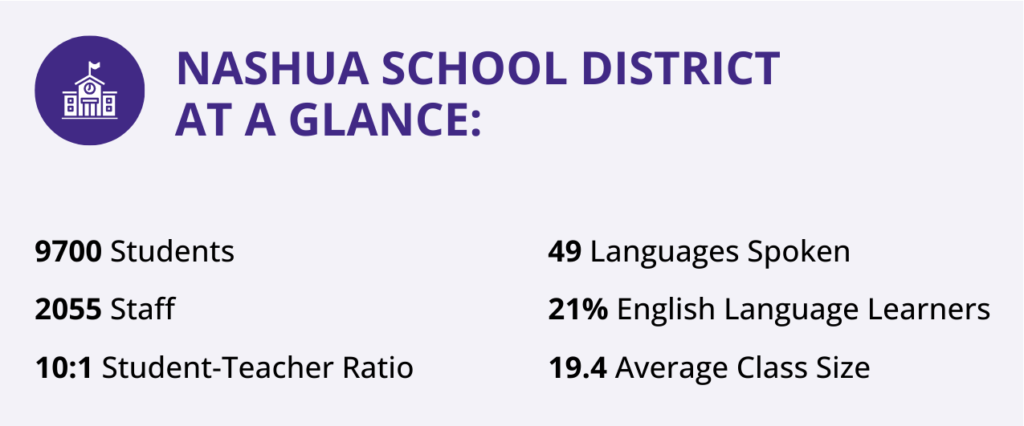
In 2022 Nashua School District reviewed their English Language Proficiency (ELP) assessment data. They noted stagnant reading scores for a subset of English Language Learners (ELLs), specifically Long-Term ELLs and late-arriving newcomers.
Digging into data and student profiles, leaders recognized an instructional gap in their English Language Development (ELD) curricular resources and the literacy needs of students. Upon exploring various literacy resources aimed at older students, they discovered other local districts having early success with SIPPS®.
This article is based on interviews with teachers and ELL leaders from Nashua’s three middle schools. Participants include Danielle Boutin, Assistant Director of English Language Learning, and Erin Putnam, English Language Learning Coordinator.
How Educators’ Experiences and ELP Data Fostered Interest in the SIPPS Program
During the 2023–2024 school year, English Language Learning (ELL) teachers and administrators at Nashua School District held discussions to determine where students were struggling and where the department needed to shift focus, based primarily on qualitative data. This included the teachers’ experience in the classroom, student interactions, and student ability to productively struggle.
Over the next year, the ELL administrative team introduced English Language Proficiency (ELP) data into the conversation. Teachers immediately began making connections between their observations and what the data indicated. This was a crucial piece in fostering teacher interest in moving forward to implement SIPPS.
How a SIPPS Pilot Prepared the Nashua School District for a Successful Implementation
Over eight weeks during the spring of 2024, two teacher leaders piloted SIPPS. Both teachers had previously taught third grade and were comfortable and well-versed in foundational skills instruction. Collaborative Classroom and the district provided training and coaching support before and during the pilot. These teacher leaders played a critical part in determining that SIPPS was a viable foundational skills curriculum.
After this successful pilot, Nashua School District decided to implement SIPPS during the 2024–2025 school year.
The district set a goal of having at least 60 percent of ELL educators teach at least one period of SIPPS in the first year of implementation, to ensure that each school had multiple SIPPS instructors. They exceeded that goal by having 80 percent of ELL teachers teach SIPPS in year one, providing an additional level of in-building support for their teachers.
Curriculum Team Workdays Helped Build a Culture of Collaboration, Trust, and Respect
To strengthen and expand their ELD curriculum, the administration put together numerous curriculum team workdays leading up to the 2024–2025 school year. The administrative leaders and teachers believe those hours spent together were crucial in helping create a team culture built on collaboration and trust.
How Professional Learning and Coaching Laid a Foundation for Effective SIPPS Instruction
Teachers had the opportunity to take part in a combination of virtual learning, in-person side-by-side coaching, and Collaborative Coaching.
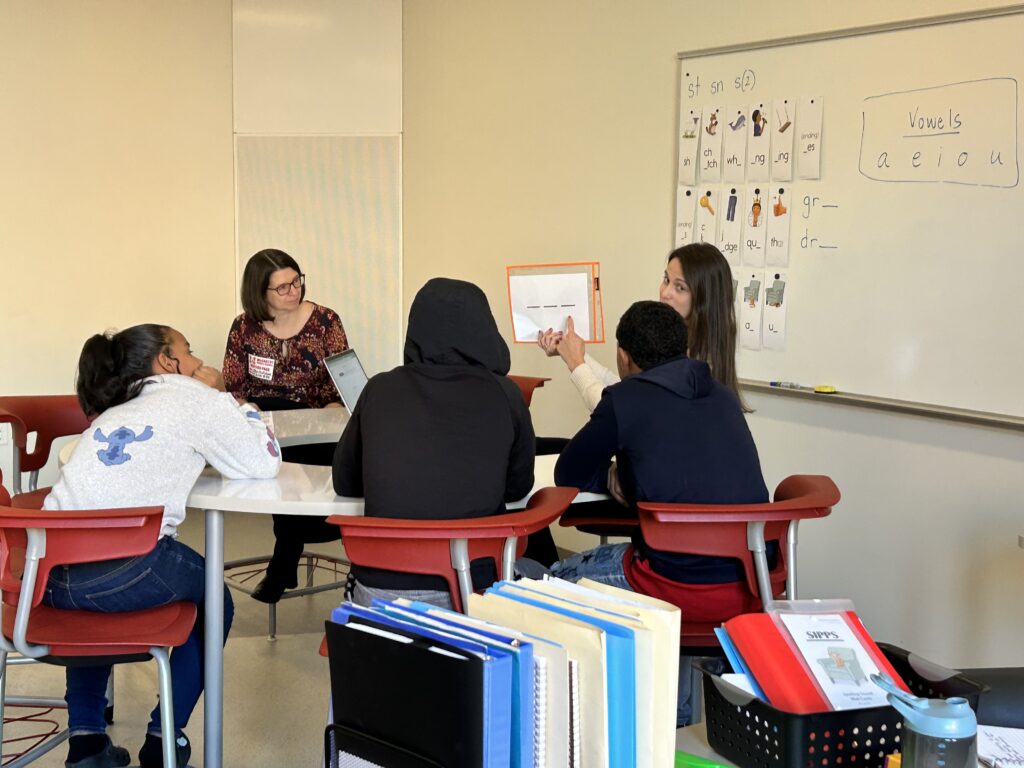
The virtual professional development sessions laid the foundation for effective SIPPS implementation. Collaborative Classroom Consultant Dr. Jennifer McMahon explained the instructional and corrective feedback routines in depth. She modeled each routine during virtual meetings, giving teachers a clear vision of what SIPPS should look like in practice.
Building on this foundation, teachers engaged in in-person side-by-side coaching. This support allowed teachers to observe one another, teach the routines in their own classes with support from Dr. McMahon, and apply real-time feedback. Teachers learned from and with each other in a collaborative, supportive environment.
ELL teachers and ELL administrators also participated in Collaborative Coach. This 1:1 virtual, personalized coaching experience gave teachers space to reflect on their instruction, receive individualized feedback, and continue refining their teaching.
Having a balance of modeling, side-by-side coaching, and individual practices from the beginning was a big factor in making sure the Nashua team was ready and willing to jump right in.
What Results Are Nashua ELL Educators Seeing After Implementing SIPPS?
The clear, concise instructional routines in SIPPS are helping ELL teachers gain confidence and strengthen implementation. Students are benefiting by quickly picking up on those routines. Knowing what to expect is helping students increase their participation and engagement.
Word study provides students an opportunity to enhance their ability to make meaning of the word segments that they are reading.
I like that we learn word parts and their meanings.
Nashua School District student
How Students Are Responding to and Engaging with SIPPS Instruction
In any classroom, students experience less anxiety and apprehension when they know what to anticipate from daily lessons and routines. In SIPPS classrooms, students always know what to expect. Responding chorally helps to lower their affective filter and keeps students actively involved in the lessons.
When Nashua administrators do walkthroughs in SIPPS classrooms, they notice how students are engaging with the routines. Teachers observe students enjoying SIPPS while gaining confidence as they experience success in their learning.
SIPPS is helping me become a better reader and writer.
Nashua School District student
What Nashua Educators Appreciate About SIPPS
Nashua educators express their appreciation for many aspects of SIPPS, most importantly the growth they continually observe in their students. Teachers are seeing positive student outcomes, particularly in the reading domain of the ELP tests.
The fact that SIPPS is designed to be developmentally appropriate for older readers is greatly appreciated. Since many other foundational literacy programs are illustrated and designed for students in grades K–2, Nashua educators really value the age-appropriate reading selections and illustrations in SIPPS.
Another aspect of SIPPS that teachers call out is how it builds background knowledge in the reading selections, giving students a chance to see what they are learning in print.
Finally, regardless of a teacher’s level of training, SIPPS provides a standardized approach to foundational literacy, allowing teachers to discuss student needs using a common language.
I’ve seen growth in student confidence in reading, along with higher reading scores.
Sarah Healy, Teacher
Specific SIPPS features that Nashua teachers say they enjoy are:
- Clearly mapped intervention
- Clearly explained correction routines
- Helpful short videos
- Wall cards
- Age-appropriate reading selections with accompanying visuals
- Scripted lessons, resulting in less planning time
- The way most lessons fit into an hour block time frame
- A card deck app that makes things streamlined without the need to fumble with physical paper
- Challenge-level vocabulary lessons that close loops for intermediate and advanced speakers, adding stronger vocabulary to their speaking and writing
Looking to the Future: What’s Next for Nashua’s SIPPS Implementation
Looking ahead to the 2026–2027 school year, the Nashua School District intends to refine the processes used to determine which students will benefit most from SIPPS instruction. ELLs often arrive in the district with varying levels of reading proficiency in their first language, so in partnership with ELL teachers, the district is creating guidance to support this process. These small adjustments will continue to improve how SIPPS is delivered.
As ELL students often struggle with decoding multisyllabic words, the district has made the decision to incorporate the SIPPS Challenge Level Vocabulary Supplement for the 2025–2026 school year.
Nashua Educators’ Insight for Other Districts Considering SIPPS
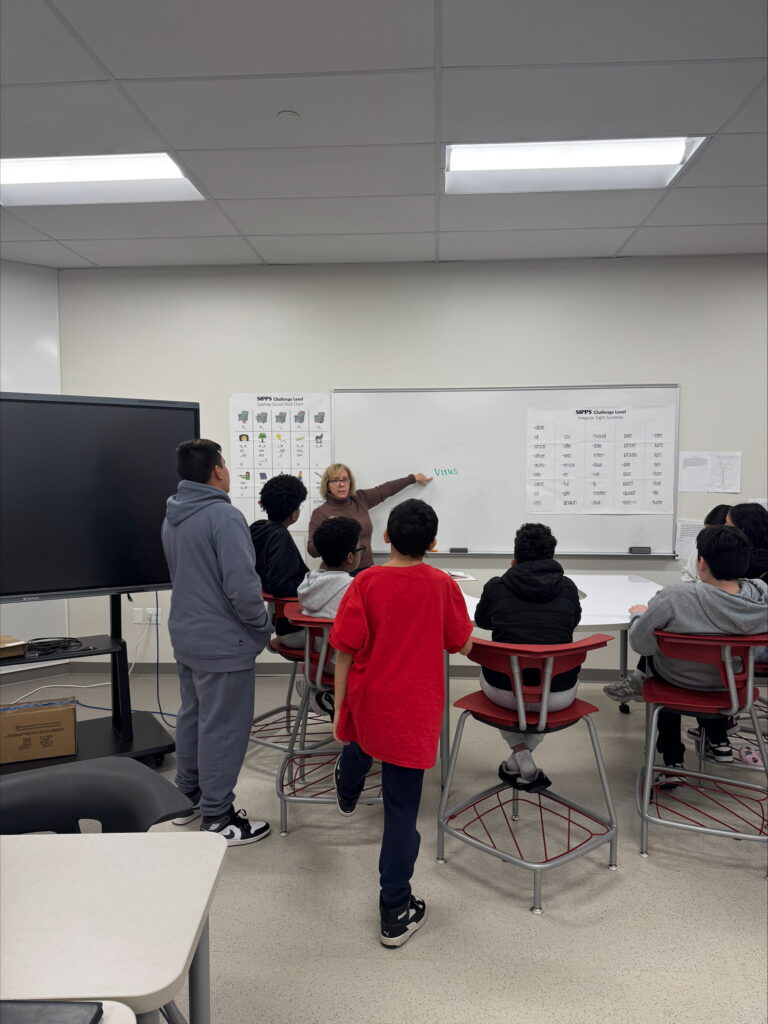
Nashua teachers recommend SIPPS as a great resource for educators, especially teachers of ELLs who do not have explicit training in foundational literacy. The curriculum and corresponding training give educators the knowledge to assist students in developing foundational literacy in an evidence-based way.
To implement the curriculum most effectively and efficiently, educators recommend that schools consider purchasing the available Collaborative Classroom training and coaching.
They further recommend considering logistical constraints for grouping and pacing, including individual student behaviors and special needs. For schools where students do one-on-one tutoring with ELL teachers, the intended pacing can be followed. For those working with groups, they may need to rotate groups and their timing.
Contributors
We thank the Nashua educators and leaders who contributed to this article, including:
Danielle Boutin, Assistant Director of English Language Learning
Danielle Boutin has devoted her career to teaching multilingual learners in the Nashua School District. For 13 years, she taught at Ledge Street Elementary School. She then worked alongside teachers for one year as a districtwide ELL coach, before transitioning into her current role as Assistant Director, which she has held for the past two years. In addition to teaching, Boutin loves connecting and advocating for families. Over the past decade, she has worked to build a strong community network she can lean on to support students and their families.
Erin Putnam, English Language Learning Coordinator
Erin Putnam has spent the last 16 years working in education in the Nashua School District. She began her career in special education at Ledge Street Elementary School and later moved into roles as classroom teacher, ELA coach, and ELL teacher. She now works as an ELL Coordinator.
Throughout all of these roles, her passion for supporting multilingual learners and her dedication to literacy instruction have remained at the heart of her work. Her primary focus is the ELL Department for grades K–12, with emphasis on K–8.
Janna Jobel
Grades 6–8 ELL teacher, Pennichuck Middle School
Karen Kariger
Grades 6–8 ELL teacher, Brian S. McCarthy Middle School
Sarah Healy
Grades 6–8 ELL teacher, Fairgrounds Middle School
Related Reading:
How Stockton’s Superintendent Is Leading Change for Reading Achievement
Interview: Empowering Multilingual Learners with SIPPS
How Age-Appropriate Texts Help Older Striving Readers Succeed
St. Paul Public Schools WINN with SIPPS Reading Intervention
How a Partnership with SIPPS Is Serving Striving Readers in California’s Juvenile Justice System
Get SIPPS for Older Readers Sample Lessons
Download lessons, text excerpts, placement assessments, and the SIPPS brochure.