
In fall 2025 Lime Street Elementary School in Hesperia, California, began implementing Collaborative Literacy as their core ELA curriculum. With this addition, the school now has instructional alignment across tiers, since they were already using the SIPPS® accelerative foundational skills program for intervention.
In this interview we hear from Lime Street educator Ellie Garcia, who teaches a combined class of fourth and fifth graders.
Ellie Garcia was interviewed by Babak Movahed, Collaborative Classroom’s Manager of Educational Partnerships for Hawaii and Southern California.
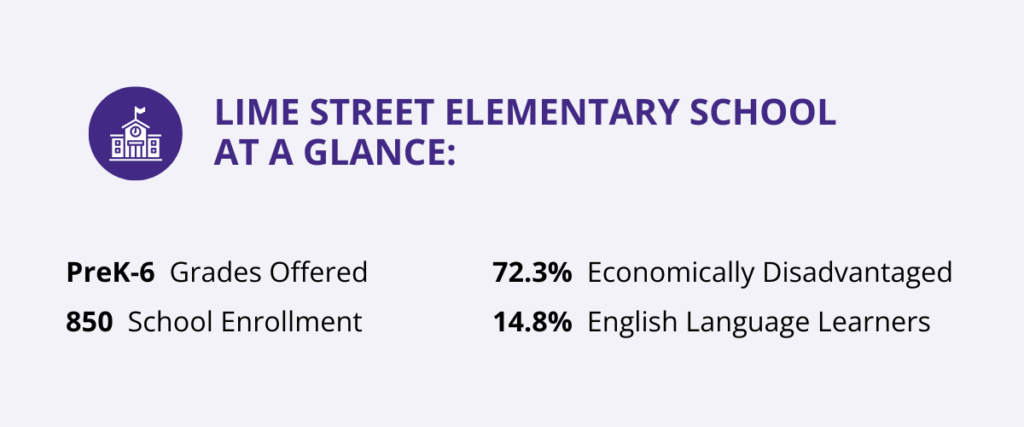
Part of the Hesperia Unified School District in Hesperia, California, Lime Street Elementary School serves 850 culturally and linguistically diverse students in kindergarten through sixth grade, 15 percent of them English Language Learners. A significant number of students face ongoing housing insecurity or are in foster care.
Lime Street places importance on integrating support for the whole child, engaging and supporting families and community, and collaborating with various partners to provide a culturally responsive and inclusive learning experience for everyone.
Babak Movahed: Ellie, would you tell us a little about your background at Lime Street?
This is my tenth year teaching at Lime Street. It can be challenging, but I find it to be the most rewarding. That’s one of the reasons why I’ve stayed at Lime so long. I’ve been able to witness tremendous growth and progression from where we were when I started to where we are now.
Thank you for sharing. I find that that’s the case with the whole team at Lime Street. Everyone seems to recognize that there are students who need assistance beyond academic support.
In terms of the academic pieces, why did Lime Street first become interested in Collaborative Literacy? What type of challenges or goals were you trying to address by implementing Collaborative Literacy?
We looked at our i-Ready data and other data points and came to the conclusion that our students struggle to read. Our students struggle with comprehension and vocabulary. They’re struggling to read and to decode words. We all know Scarborough’s rope: if they can’t read or decode words, then they can’t comprehend.
I use the metaphor of an emergency room. Students were coming to us in fourth and fifth grade needing surgery. They needed really intense intervention, because they could not decode. We understand that sometimes by the time they get to fourth and fifth grade, students might need a cast or some stitches, maybe an X-ray, but they should not be bleeding out on the table, which is what was happening.
The kids couldn’t write; they couldn’t read. And that was the catalyst for everything. Their inability to read was also affecting their math scores—their ability to comprehend or answer a math problem. It was all interconnected.
Literacy is the foundation for all learning. So that’s really what moved us as a school to take some concrete steps to remedy the situation. We brought in Collaborative Literacy as our core curriculum in fall 2025. To triage the correct way, and not have to perform emergency surgery by the time they’re entering fifth grade.
Exactly. It‘s been said, “You can’t intervene your way out of a Tier 1 problem.” Adding Collaborative Literacy as your core curriculum alongside SIPPS as your intervention program means that for the first time, Lime Street now has true alignment across tiers of instruction. That’s an exciting development.
I realize that it’s only been a few months since you began using Collaborative Literacy, but what are you seeing so far?
Our i-Ready scores are promising. Test scores have improved but it’s too soon to tell if those results are from SIPPS or our new Collaborative Literacy implementation. [Lime Street began using the SIPPS foundational skills program for intervention two years ago.] Since this is our first year with Collaborative Literacy, we look forward to having more solid data next year.
I look forward to learning about that data with you next year, too, now that Lime Street has both Collaborative Literacy and SIPPS in place.
Returning to Collaborative Literacy, what do you appreciate about the program now that you’ve been teaching it for a few months? What do your fellow educators appreciate about it?
I appreciate the level of conversations that I hear my students engaging in. I love the selection of diverse texts. The separation of word study from the reading lessons is so powerful.
The kids love the word study. They love getting together to take apart words and then be able to read suffixes and prefixes that they didn’t know before. I had a student who was reading at a kindergarten level. He was asked to read a word that ended with the syllable “-tion”. He knew that syllable because it was something that he had gone over in word study. The ability to apply that study to what he was reading was very impactful for him.
You touched a little bit upon this already, but I’m curious to dig a bit deeper. What have you noticed about your students’ level of learning and engagement, and what have your colleagues noticed?
I’ve noticed students are more comfortable in having conversations and discussions. They build upon, clarify, and confirm each other’s thinking all day. We were in the library and the librarian was reading us a story, and, after she was done, she was so impressed with the way students were engaging with the text. They were participating in discussions, saying things like, “Well, in addition to what so-and-so said, I think ….” Or, “I don’t know—I disagree with this person. I don’t think that the wolf was telling the truth because x, y, z.” Their ability to use those sentence stems to share their thinking in different spaces is remarkable.
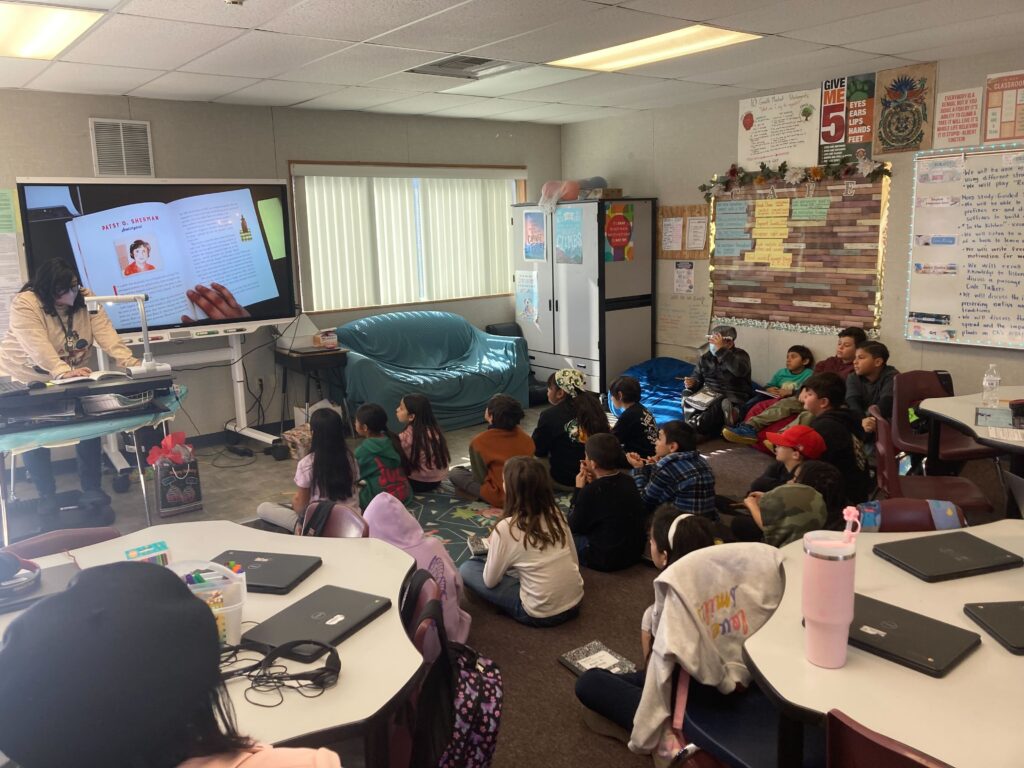
They’re also expanding their knowledge by seeking out ways to learn more on their own. We were reading a book about Navajo code talkers, and one of my students went to the library to check out another book on the subject because they were so intrigued by what we were learning in class.
People who visit our classrooms comment on the high level of discourse, and how attentive students are to each other and to their community.
Thanks for sharing that. Seeing your classroom a couple times, it was apparent that you have this intentionality of showing the through line between reading and writing, and thinking about the whole picture of ELA versus these little segments.
To wrap up, what thoughts or insights would you share with any school or district that’s considering Collaborative Literacy?
Tackling literacy can be an enormous undertaking but it doesn’t need to be overwhelming. Collaborative Literacy lays everything out for you. We discussed in our textbook adoption committee our desire to pay close attention to access, equity, and diversity, as well as an emphasis on teacher instructional planning. Prior to adopting Collaborative Literacy, I would spend so much time planning for teaching reading and for teaching writing. There were all these things that I thought I had to do and they weren’t necessarily the right steps.
Any school or district considering Collaborative Literacy can depend on the curriculum being laid out very clearly, very intentionally. It’s laid out in a way that makes planning time much easier, and actually cuts down on planning time. All you need to do is read through the lesson. The sidebar lists what you’ll need for each lesson. The week at a glance helps in preparation by reminding you, for example, to put an anchor chart here, or put a projectable up here. It’ll tell you what page we’re looking at in the student response books or in their word study books.
Support for Multilingual Learners
It was a relief to have an intentional curriculum that contains all of the supports for emerging bilinguals. I appreciate the way the curriculum embeds cognates into word study to facilitate vocabulary instruction for emergent bilinguals. I also appreciate the distinction between suggested vocabulary and ELL vocabulary. Previously, I may not have clarified the items that are in the ELL vocabulary.
I will tell anyone who’s exploring this curriculum and really tackling literacy at their school, just know that the structure is there for you. The script simply provides the foundation and groundwork for you to add your own personality and authenticity to the teaching. I don’t feel my independence or freedom is being infringed upon at all. I like to have a lot of individuality in the way that I do things, and Collaborative Literacy gives me a foundation upon which I can add my own flair and style.
Related Reading:
The Reading League Publishes a Curriculum Navigation Report on Collaborative Literacy
Collaborative Literacy in California for 2026
California, Get Ready for Collaborative Literacy!